How it could look
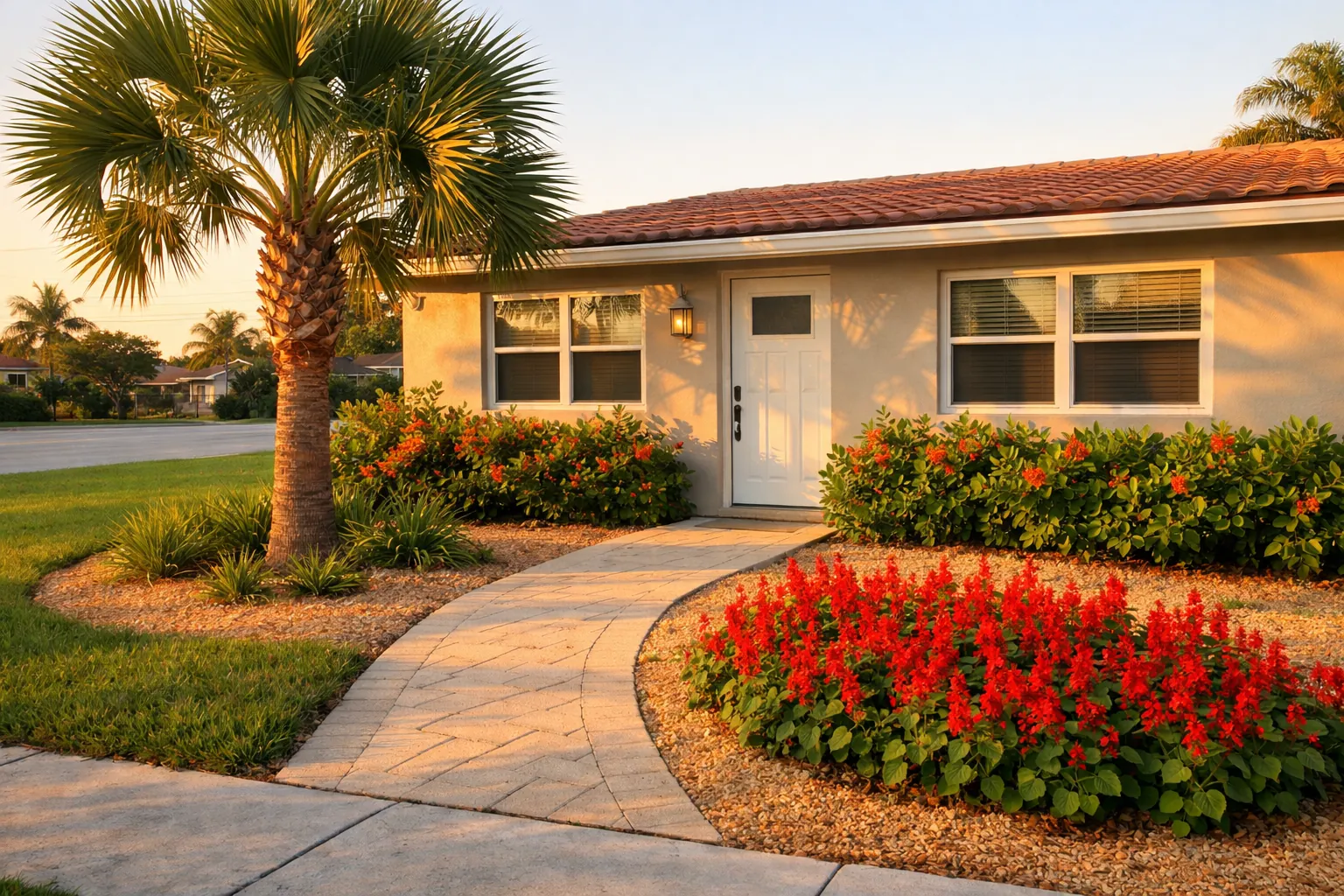
The plants in this picture

Hamelia patens flower and buds at Kanhangad · Wikimedia Commons Firebush

Chrysobalanus icaco (fruit) · Wikimedia Commons Cocoplum

Sabal palmetto kz01 · Wikimedia Commons Cabbage palm

Alex Abair · CC BY 4.0 Tropical sage
Growing your garden…
- Difficulty
- intermediate
- Hours
- 13
- Cost
- $589
- Watering
- About 13 gal a week for this bed. Summer rain covers much of this.
DIY, one person
First season
Foundation planting, once established
Your plants
Zone 10 · Miami, United States · Tropical
Tropical front yard for a part-sun Miami, United States site
Miami is zone 10: Winter days are often the mid-70s°F and nights around 60°F. Summers sit in the upper 80s to low 90s°F. The tropical style is natural in this climate. A tropical concept for a part sun yard in Miami, United States, about 400 sq ft, facing east. The bones are Firebush, Cocoplum, cabbage palm, arranged for pollinators, curb appeal, pets. The first season comes in under a $800–$2,500 budget.
This season
Spring: The late dry season, March to May, is a good time to plant before the rains.
First job. Call 811 before you dig. Mark the front walk and the edges of the foundation bed and the front bed, then live with the lines for a day.
Overall this is an intermediate plan because of the care. Plants are beginner, the build is beginner, and the ongoing care is intermediate. The beds, mulch, and planting are DIY. No lighting or pumps are specified, so an electrician is not required.
Hours of work
Building it is about 13 hours for one person, or 6 hours on site for a two-person crew. A typical two-person crew would be about $780 in labor, before materials. This is an estimate, not a quote.
About 56 hours of DIY care over the year, and about 6 hours in the busiest month. Those hours are already on the care calendar.
| Task | Phase | DIY | Crew |
|---|---|---|---|
| Clearing | 1 | 2.5 h | 1 h |
| Soil preparation | 1 | 3.5 h | 1.5 h |
| Hardscape | 1 | 0.5 h | 0.5 h |
| Planting | 2 | 2.5 h | 1 h |
| Irrigation | 2 | 3 h | 1.5 h |
| Mulching | 3 | 1 h | 0.5 h |
DIY hours are for one person. Crew hours are the time on site for two experienced people, who are faster than half of one. The price is an estimate of their combined hours. It is not a quote.
Build schedule
One person takes 16 calendar days. Three people take 16 calendar days. On this small job each task already fits in one work day, so more people do not shorten the calendar. Deliveries and curing would not shrink anyway.
With 1 person this build is 16 calendar days (6 days on site). Care afterwards is 56 hours over the year, not part of this build.
- Week 1, day 1. 1 person on Clearing (2.5 h)
- Week 1, day 2. 1 person on Soil preparation (3.5 h)
- Week 2, day 8. 1 person on Hardscape (0.5 h)
- Week 2, day 9. 1 person on Irrigation (3 h)
- Week 3, day 15. 1 person on Planting (2.5 h)
- Week 3, day 16. 1 person on Mulching (1 h)
1 DIY worker, 6 hours a day, 2 days a week. Order plants so they arrive while you clear and prepare the soil. Curing does not get shorter with more people. Planting stays inside the local season.
Sun and shade
Shade is estimatedShade is estimated from which way the space faces. It is not a measurement of the buildings or trees next door.
| Zone | spring | summer | fall | winter |
|---|---|---|---|---|
| Open sun | 3.5 hPart shade | 4.5 hPart shade | 3 hPart shade | 2 hFull shade |
| Edge | 2.3 hFull shade | 2.9 hFull shade | 2 hFull shade | 1.3 hFull shade |
| Shade | 1.2 hFull shade | 1.6 hFull shade | 1 hFull shade | 0.7 hFull shade |
What this place asks of the plan
- Winter days are often the mid-70s°F and nights around 60°F. Summers sit in the upper 80s to low 90s°F. About 60 inches of rain, mostly May to October.
- Frost here: Effectively frost-free. A rare cold front can still burn tender leaves.
- The soil is Sand and limestone. Nutrients leach. Some yards are fill over rock.
- Summer rain is ample. Water new plants in the dry winter and during the first establishment.
- Pick wind-firm plants and keep brittle trees away from the house.
- Choose plants that tolerate salt spray, and rinse foliage after a storm if you can.
- Plant into the sand and limestone you have. A pocket of rich soil will not stay rich.
- Plant before the hottest weeks, and water new plants through the first dry spell.
- This is one of the few cities on the list where a tropical palette is the local one.
- Native-plant source: University of Florida IFAS Extension; Institute for Regional Conservation, Natives for Your Neighborhood.
Care, in brief
In the dry season, roughly November to May, about 74 gal a week for the whole planting. That is the beds once the planting is established.
A year of water, fertilizer, mulch and replacement plants is about $123 before any professional help.
- Tree
- Bed
- Path
Tint is summer sun: gold is full sun, green is part shade, blue is full shade.
Top of the drawing is the house. The walk runs toward the street. Distances are a concept, not a survey.
- 1.Firebush · Hamelia patens
- 2.Cocoplum · Chrysobalanus icaco
- 3.Tropical sage · Salvia coccinea
- 4.Cabbage palm · Sabal palmetto
How to read the site
- Miami, United States · zone 10
- Front yard · faces East · part sun
- Sandy soil · Tropical · 400 sq ft
- Working toward pollinators, curb, pets.
- Shade is estimated from which way the space faces. It is not a measurement of the buildings or trees next door.
This is one of the few cities on the list where a tropical palette is the local one. Big leaves and hot color do the work. Plants are grouped in masses along the walk and the foundation.
The rest of the year
- Summer is hot, wet, and stormy. Do not stake your year on a transplant in August.
- As the rains ease, fall is a strong planting season.
Layout zones
Front walk
A walk from the sidewalk to the door.
Hardscape — no plants assigned.
Foundation planting
A low row of shrubs along the house, kept below the windows.
Firebush · Cocoplum
Small front tree
One small tree to the side of the walk.
Cabbage palm
Front bed
A short bed of flowers or grasses beside the walk, scaled to a small front yard.
Tropical sage
Plants and why

Firebush
× 3
Hamelia patens
A south-Florida native shrub with orange tubes that hummingbirds use all year. In the foundation planting it feeds pollinators through nearly year-round in south florida.

Cocoplum
× 3
Chrysobalanus icaco
In the foundation planting it feeds pollinators through .

Cabbage palm
× 1
Sabal palmetto
The native palm of Florida and the coastal Gulf. In the small front tree it feeds pollinators through .

Salvia coccinea
It is a short-lived perennial that reseeds, not the Brazilian bedding annual Salvia splendens. In the front bed it feeds pollinators through spring through fall, and nearly year-round in south florida.
Care
Drip or a soaker in the beds, and a can for anything in a pot. Water in the morning.
Miami is not a restriction city. Summer rain is ample. Water new plants in the dry winter and during the first establishment.
Watering
First season is the establishing year. After that, use the established column.
Foundation planting
| Season | First season | Established |
|---|---|---|
| Spring | About 53 gal a week for this bed. This is the dry season, so do not skip it. | About 33 gal a week for this bed. This is the dry season, so do not skip it. |
| Summer | About 21 gal a week for this bed. Summer rain covers much of this. | About 13 gal a week for this bed. Summer rain covers much of this. |
| Fall | About 17 gal a week for this bed. | About 17 gal a week for this bed. |
| Winter | About 37 gal a week for this bed. This is the dry season, so do not skip it. | About 37 gal a week for this bed. This is the dry season, so do not skip it. |
Small front tree
| Season | First season | Established |
|---|---|---|
| Spring | About 13 gal a week for this bed. This is the dry season, so do not skip it. | About 8.5 gal a week for this bed. This is the dry season, so do not skip it. |
| Summer | About 5 gal a week for this bed. Summer rain covers much of this. | About 3 gal a week for this bed. Summer rain covers much of this. |
| Fall | About 4 gal a week for this bed. | About 4 gal a week for this bed. |
| Winter | About 9 gal a week for this bed. This is the dry season, so do not skip it. | About 9 gal a week for this bed. This is the dry season, so do not skip it. |
Front bed
| Season | First season | Established |
|---|---|---|
| Spring | About 40 gal a week for this bed. This is the dry season, so do not skip it. | About 25 gal a week for this bed. This is the dry season, so do not skip it. |
| Summer | About 16 gal a week for this bed. Summer rain covers much of this. | About 9.5 gal a week for this bed. Summer rain covers much of this. |
| Fall | About 12 gal a week for this bed. | About 12 gal a week for this bed. |
| Winter | About 28 gal a week for this bed. This is the dry season, so do not skip it. | About 28 gal a week for this bed. This is the dry season, so do not skip it. |
Fertilizer
Foundation planting, Small front tree
Compost, or a slow-release balanced fertilizer around 10-10-10
Once in local spring (March to May), after growth starts. Do not feed in late summer.
Front bed
An organic flower food or a lower-nitrogen 5-10-10
At the start of local spring, and again in early summer (June to August) if they are still growing hard.
The whole plan
Compost only, unless a pot is clearly pale
Skip the midsummer feed. A low-care planting is easier to overfeed than to starve.
Sand: work compost through the top of the bed and keep mulch on it, or water runs through before the roots drink.
Month by month
January
3 h DIY
- This is the dry season. Water new plants and containers when the mix is dry.
February
3 h DIY
- Shape shrubs after they flower. There is no cold stop to wait for.
March
5 h DIY
- Spread mulch and compost before the rains. Start feeding once growth is moving.
April
5 h DIY
- Walk the garden and water only what is dry.
May
6 h DIY
- Walk the garden and water only what is dry.
June
6 h DIY
- Summer rain is starting. Water only what a storm missed.
July
6 h DIY
- Pause fertilizer in a heat wave. Let the summer rains do most of the watering.
August
6 h DIY
- Walk the garden and water only what is dry.
September
5 h DIY
- Refresh mulch where storms have thinned it.
October
5 h DIY
- Plant and mulch as the rains ease. A cold cover is not part of this climate.
November
3 h DIY
- The dry season is starting. Water new plants if a week passes without rain.
December
3 h DIY
- Water containers when the mix is dry. Keep going through the dry season.
Yearly running cost
DIY running cost for a year. Professional help is optional and is not included in the yearly total. Water is a rough utility estimate, not a bill.
- Water
- $20
- Fertilizer
- $37
- Mulch
- $41
- Replacement plants
- $25
- DIY year
- $123
- Optional professional visits
- $330
Shopping list
Quantities come from the spacing and the area of each bed. Prices in USD. They are not quotes. Sources for the plant choices are named on the plan.
| Plant | Qty | Size | About |
|---|---|---|---|
FirebushBeginner Hamelia patens | 3 | 5–8 ft tall, 48 in apart | $114 |
CocoplumBeginner Chrysobalanus icaco | 3 | 4–10 ft tall, 48 in apart | $114 |
Cabbage palmBeginner Sabal palmetto | 1 | 20–40 ft tall, 120 in apart | $155 |
Tropical sageBeginner Salvia coccinea | 8 | 2–3 ft tall, 12 in apart | $112 |
Soil test Material · phase 1 | 1 test | $32 | |
Compost for new beds Material · phase 1 | 112 sq ft | $36 | |
Hardwood mulch, 2 inches Material · phase 1 | 112 sq ft | $47 | |
Drip irrigation starter Material · phase 1 | 1 kit, plus tubing | $91 | |
Bed edging Material · phase 2 | 42 linear ft | $88 |
Materials and budget
Target $800–$2,500 · a year of care is about $123
First season
$589
Working list
$789
Untrimmed idea
$789
The first season comes in under budget, with $211 left. Optional upgrades are listed separately. Figures are DIY materials at rough retail prices. Labor, delivery, and tax are not included.
Optional upgrades
- One more Firebush — about $38
- A larger nursery size of the Cabbage palm — about $155
- Extra bed edging — about $42
| Item | Quantity | Phase | Amount |
|---|---|---|---|
Soil test | 1 test | 1 | $32 |
Trees | 1 plants | 1 | $155 |
Compost for new beds | 112 sq ft | 1 | $36 |
Hardwood mulch, 2 inches | 112 sq ft | 1 | $47 |
Shrubs | 6 plants | 1 | $228 |
Perennials | 8 plants | 2 | $112 |
Drip irrigation starter | 1 kit, plus tubing | 1 | $91 |
Bed edging | 42 linear ft | 2 | $88 |
Phased plan
Phase 1
Bones and soil
Plant the woody structure in the cooler months, and pause major planting in peak summer.
Mark, dig, and plant the things that should still be here in ten years.
- Call 811 before you dig. Mark the front walk and the edges of the foundation bed and the front bed, then live with the lines for a day.
- Sandy soil drains fast. Work compost through the beds and keep mulch on them so water stays long enough to matter.
- Plant the cabbage palm with the root flare at grade, then water it slowly until the root zone is wet, not just the surface.
- Mulch beds 2–3 inches and keep the mulch off trunks and crowns.
- Water new woody plants about once a week when rain does not, for the first growing season.
About $589 in materials in this phase
About 6.5 hours for one person, or 3 hours for a two-person crew.
Phase 2
The planting
The next planting window after the bones are in and watered.
Fill the beds once you know the path and the tree are in the right place.
- Repeat a plant you already have before you add a new species.
- Lay drip on the beds before the plants knit together. It is miserable to snake tubing through plants that have already filled in.
- Weed weekly the first month. After that, mulch should do more of the work.
About $200 in materials in this phase
About 5.5 hours for one person, or 2.5 hours for a two-person crew.
Phase 3
Finish and repeat
Once the first plants have rooted, usually the following season.
Annual color, deferred hardscape, and the edits you only notice after a season.
- Add annuals only after the woody plants have put on a season of roots.
- If a gap still bothers you, repeat a plant you already have before you introduce a new one.
- Leave a few spent flowers if you want seed, and cut the rest when they look tired.
- Walk the yard in the month you started and edit one thing: a plant in the wrong light, a path that is too narrow, a bed that is too wide to reach.
About $0 in materials in this phase
About 1 hour for one person, or 0.5 hours for a two-person crew.
Before you dig
- Call 811 before you dig. This drawing is a concept, not a survey, and it does not know where your utilities are.
- Common toxic plants in this catalog — hosta, daylily, hydrangea, holly, clematis, and allium — were left out because pets use the yard.
- Check invasive-plant rules locally before you substitute anything, especially vines and groundcovers.
- The plant list is short because the combination is strict. Widen the sun, relax pets or kids, or confirm the zone if this looks too thin.
Ask a follow-up
Practical notes, not a site visit
Ask about a plant, a month, the soil, or this plan. Answers use the plant library and the concept in front of you.
Goals in this brief: Pollinators, Curb appeal, Pets.